

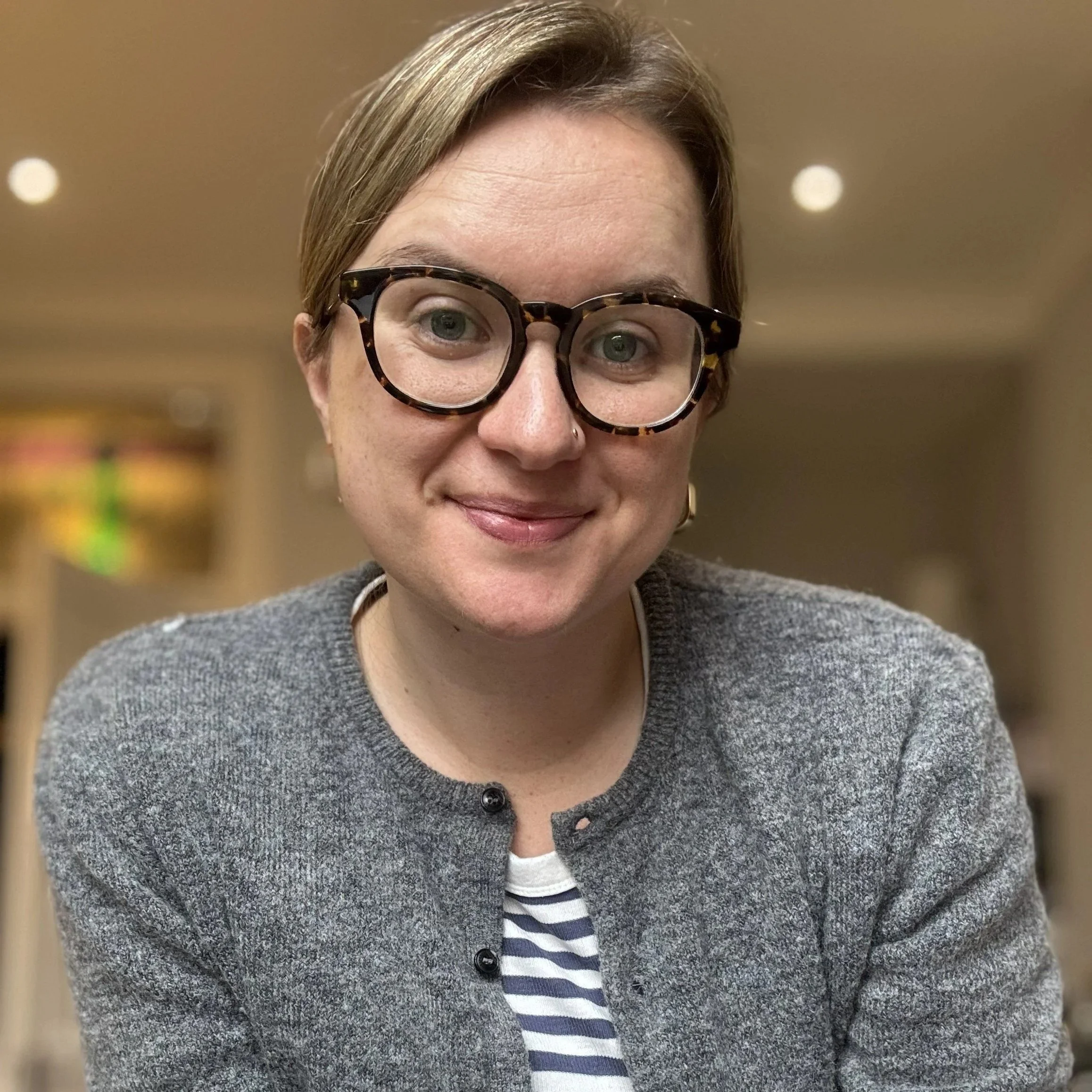
Madeleine Hayman, MBACP
Psychotherapist | Researcher | Educator
Experience client-centred psychotherapy rooted in empathy, flexibility, and evidence-based practices.
I believe that exploration and learning can foster growth that is long lasting. That does not mean to change who you are, but to understand yourself in new ways. Growth isn’t linear or follow any direction, but it can sometimes feel transformative.
It is also a fundamental belief of mine that in processing difficult emotions, loss, grief, trauma, and the other facets of being human allow us to live life to the fullest, enabling us to connect with others are form lasting relationships with friends, family, lovers, and/or ourselves.
I offer psychotherapy that is driven by empathy, understanding, and supporting you every step of the way. I use cognitive and behavioural methods in order to empower clients to make changes that matter for them. I draw on other modalities such as person-centred, relational, and schema therapy to offer an eclectic approach that is tailored to every clients needs.
My practice acknowledges the differences in every experience, and the things that matter to my clients such as identity, spirituality, and culture. In our sessions, I encourage clients to bring their authentic selves, and if that is not possible at first we work at the best pace until we have formed the trust needed.
I believe that everyone should be able to experience what it is like to accepted as you are, but it is unfortunate that it is never that simple. Therefore, I offer concessionary rates for income-based needs, students, and trainees. I also take a few clients completely for free to continue to give to the community in which I work.

-

My Virtual Practice
I offer online telehealth sessions across the UK with adults over the age 18. I use a secure network, always protecting you data and privacy.
-

My In-Person Practice
I offer in-person sessions to those in the Glasgow area. My therapy space is conveniently located along the subway line for easy access.



New to therapy? Questions to consider when looking for the right therapist
What does finding the right therapist mean?
It’s important for you to know that the term therapist is not a regulated profession in the UK. That means that unfortunately anyone can call themselves a therapist, psychotherapist, counsellor etc. But fear not, because there are ways to determine if someone has had sufficient training or not. The biggest indicator is being registered to a counselling/psychotherapy organisation like the British Association for Counselling and Psychotherapy (BACP), Counselling and Psychotherapy in Scotland (COSCA), and UK Counsel for Psychotherapy (UKCP) to name a few.
These organisations provide an ethical framework for practitioners to abide by and offer support, education, as well as minimum requirements for practice for those to be eligible to be members.
I am a member of the BACP and you can also find me on their registry. You can also find me on Psychology Today.
How long does therapy take?
This will vary for all therapists, but for me I offer tailored plans to suit your needs in therapy. But some therapist work on more strict sessions plans. For me, I use your goals and focuses of therapy to discuss how often we might meet and for how long.
What is your experience like?
This is great question to ask potential therapists! For example, if you are looking for a couples therapist, it would be ideal for the therapist to have experience in working with couples. I predominantly work on a 1-on-1 basis with adults only. My expertise is for the most part generalist, meaning that I have worked with an array of different things and ages. Ages I have worked with range from 18-78 thus far. You can learn more about topics I have experience with in my about me page.
What makes a good therapist? What should I be looking for?
There are a number of things that make a therapist the right fit for you. First and foremost, a therapist should have relevant training for being a mental healthcare professional, for me that is my postgraduate diploma in cognitive behavioural therapy and my subsequent developmental training.
Additionally, while it may vary from person to person a good therapist will be open-minded, non-judgmental, and not make you feel shame or bad for what you say. It is a therapists role to provide a safe space for you to explore. Most importantly they should listen to you.
You will know if the therapist is the right fit for you - trust your gut. However, it is important to remember that a therapist is an un-biased professional who is there to guide you in your journey - what this means is therapy isn't easy and sometimes sessions are hard; but a good therapist will hold the space and ensure support while navigating those sessions.
If for example, and for whatever reason, we are not a good fit I will do my best to suggest or signpost to other therapists who better meets your needs.
What is the sliding scale for session fees?
Accessibility is important and therapy is an investment. Many therapist offer a sliding scale to help with accessible options. I use a scale myself and am currently trying to align for folks to use health insurance to cover costs as well. Students, therapist trainees, and low-income folks are eligible for reduced fees. I also take a few clients at a time who is eligible for my For All Scheme where clients do not pay any fees.

Contact Madeleine
madeleine@mindfulwithme.co.uk
City Centre, Glasgow
Scotland, United Kingdom