
Overthinking and People-pleasing… it’s exhausting
You could say I am an expert in overthinking… as in I’ve been doing it for a long long time. It wasn’t until I realised that it was using up so much energy and time that I thought maybe this was something that needed to change.
For me, overthinking meant second guessing myself, in particular when I had to make decisions in front of other people. What does that look like you may ask? I could give you hundreds, because when you are an ‘over thinker’ there are no limited to the worries that you have.
‘Was that the right thing to say?’
‘Are they mad at me because they haven’t responded yet?’
‘What if everyone thought I was talking nonsense?’
The questions are like a snow flurry, swirling around in your brain making it hard to consider anything else. What I had to learn was that most of the worries were fuelled by my inner critic.
Everyone has one, but we all might call it something different. For some, the inner critic isn’t their own voice but the echoes of a parent who told them they weren’t good enough at something or a past lover you constantly told them they were useless. The inner critic is often a voice or thought of negative self-belief.
In CBT, we often refer to these as core beliefs. In Melanie Fennels 1996 model of treating low self-esteem, she refers to them at bottom lines.
In psychology, they are broadly referred to as schemas.
There are more names for them depending on which framework you use, but they all refer loosely to their unconditional underlying beliefs that are supported easily by evidence that you think fits, and when evidence is presented against them, well… they often refuse to believe that evidence is real.
I link to think of the inner critic a bit like a playlist you can’t seem to shut off. As humans, we may have many in this playlist, constantly on shuffle. These beliefs can even cycle from being about you, others, or the world. And it is simply exhausting when they are taking up space in your brain.

So how does the inner critic get so good at being loud?
I think it has to do with awareness, or lack there of.
When we have an inner critic who is shouting ‘you suck’ all the time, you start to believe it. But the real kicker is until something points out that that the inner critic isn’t really being fair, breaking that cycle still feels impossible.
However, there is strength in knowing that there is this innate bias to your inner critic; things can become clearer. You can take back control and really ask yourself — is that true? Is the inner critic saying something where there is more evidence to support it or not?
I hazard guess, that it often isn’t.
Once you notice your inner critic’s voice isn’t rooted in logic - what comes next?
The answer? Finding out what lay’s beneath it.
For many overthinkers it can lead to different behaviours, one example being a people-pleaser.
It’s automatic.
The need to fix the problem because there is a chance that the negative core belief will be confirmed. For example, a person can learn from a young age that when people like you, that good things happen.
But when people don’t like you…it can mean something far more scary. Whether it’s the risk of abandonment, safety, or simply feeling unloved. These experiences leave lasting impressions.
For many who people-please, it can be maintained by our thoughts… which is not great when all you do is overthink. Check out the iceberg below to see how these thoughts may act as a cascade leading to the ultimate fear.
In this case it’s ‘I will be in danger’ which can easily be translated to ‘I might die’. The core belief can be anything, but many who experience this level of fear in childhood may lean toward the belief of being unlikable, or unlovable.
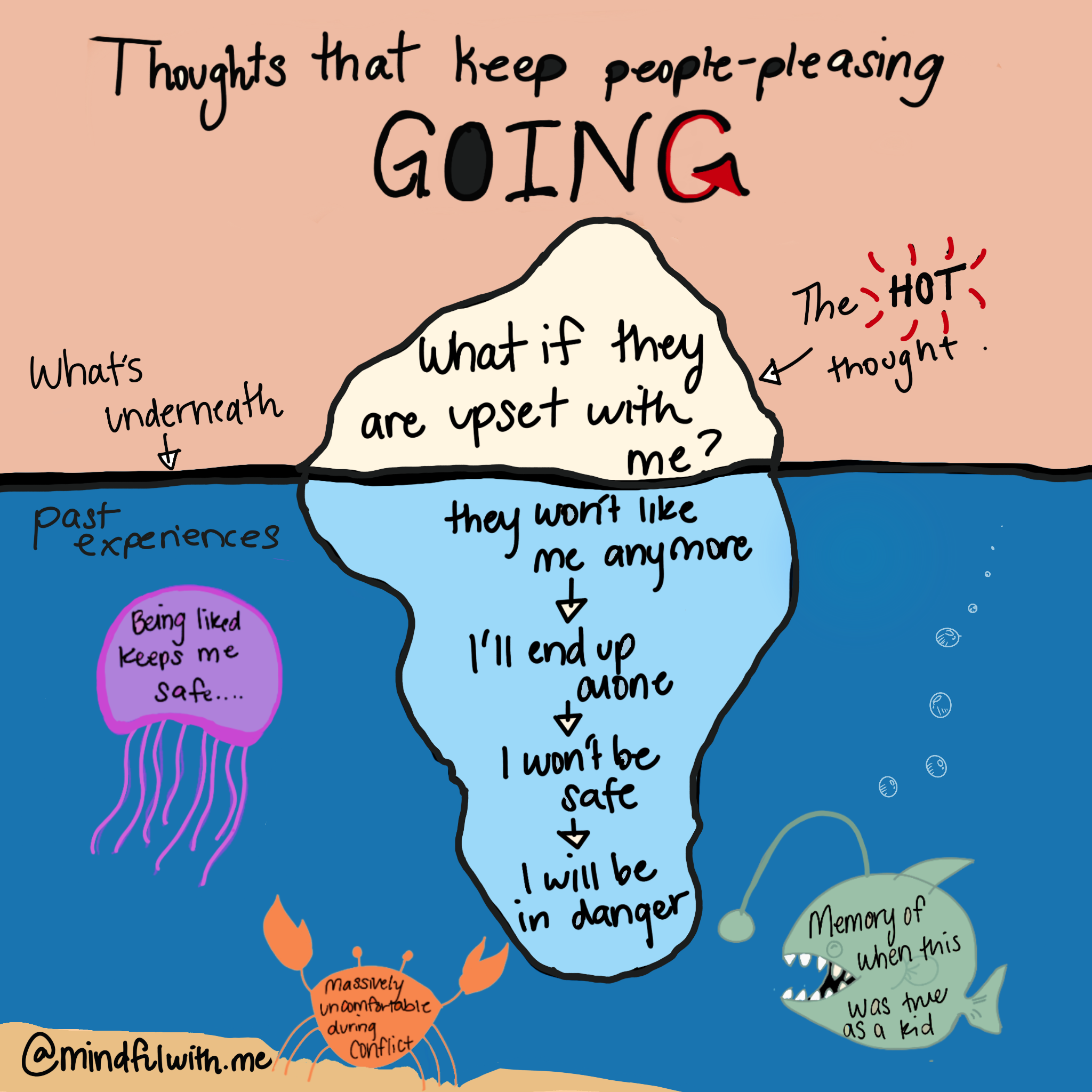
Inspired by the @creative.clinical.psychologist on IG — my own iceberg showing the thoughts that may follow the initial hot thought that tends to push us to act… or not act.
It is in unpacking all the stuff that lies beneath the surface (like in the image above) that can help overthinkers [and people-pleasers too] unlearn the beliefs that don’t have any evidence to back them up. It largely boils down to reclaiming your self with alternative ways of thinking and finding balance with you are are.
This does not mean erasing your past or even trying to rewrite your story. This reclamation is one solely for you. Of course, when you are able to not be bogged down by overthinking or constantly worried about others, you can engage in your relationships and community more authentically.
You may have noticed that I haven’t given any tips or tools for this tendency… and the truth is that it’s a real process. To unlearn, and learn for the very first time, how to take things as they are without spiralling. I suppose this post isn’t a resource per se, but a statement of solidarity.
I have been a die hard overthinker for a long time, but now through the help of others like my very own therapist, I can say it doesn’t have to be the only way to exist.
So dear reader, I see you. There is hope yet.
