
The art of reflection: start with a moment in time
When I teach university students, one of their biggest hurdles is the reflective writing assignment. Many are confused by the very idea of reflection, and some even mock it. I give them grace, because they’re not wrong—reflective writing is genuinely difficult.
We rarely receive explicit instruction on how to reflect; it often happens unconsciously. If you mess up at work and think, “I don’t want to repeat that,” that’s reflection. If you end a relationship because your partner constantly puts you down and then think, “My next partner should respect me,” that’s also reflection.
Reflection has been studied extensively, which is valuable, but it doesn’t always have to be complicated. In therapy, reflection is a core skill for both therapist and client. When you can reflect, you learn. I admit my students sometimes groan when I announce we’ll be using active reflection, yet by the end many (so far) comment that they never realized how eye‑opening reflection could be.
The student world differs from the “real” world, so reflection often gets pushed to the back burner (or hob—I know “burner” is an Americanism). It doesn’t have to stay there. In fact, there’s a simple way to begin reflecting, especially when you notice things aren’t turning out as you hoped.

Image of a man rubbing his eyes in a dark and dim room, sitting on a couch.
Step 1 – Notice the Moment
Identify the exact point when something shifts—when you go from “doing alright” to “angry,” or any other uncomfortable emotion or sensation.
Pinpoint the moment: What happened? Where were you? Who was present? What day and time was it?
Tip: Stay anchored in this moment for the purpose of reflection.
Step 2 – Capture the Core Elements
Write down the four key components of the experience: emotions, thoughts, bodily sensations, and behaviours.
Step 3 – Detail Each Category
For each component, record what you experienced in that moment.
Be specific—capture as much as you can remember.
If a section feels stuck, move on; there’s no pressure to fill everything perfectly.
Step 4 – Review Your Notes
Read what you’ve written. What stands out? Examine each section individually first.
Step 5 – Highlight the Strongest Emotion
Mark the emotion that felt most intense.
Step 6 – Identify the Central Thought
Underline the thought most closely linked to that strong emotion.
Step 7 – Evaluate Behaviors
Note any behaviors you liked or disliked.
Step 8 – Synthesize the Reflection
Consider the whole picture: What does this moment mean to you?
Step 9 – Plan for the Future
Ask yourself whether you’d act the same way or differently if a similar situation arose.
Step 10 – Repeat as Needed
Use this process whenever you need it.
In CBT this tool goes by several names—Five‑Factor Model, Hot‑Cross‑Buns, or 5 Concepts—all stemming from Christine Padesky’s 1995 book Mind Over Mood (itself inspired by Aaron and Judith Beck). You don’t need to purchase the book to apply the technique, although if you want a deeper dive, it may be useful but the free option works too.
Below is a quick example to illustrate the process.
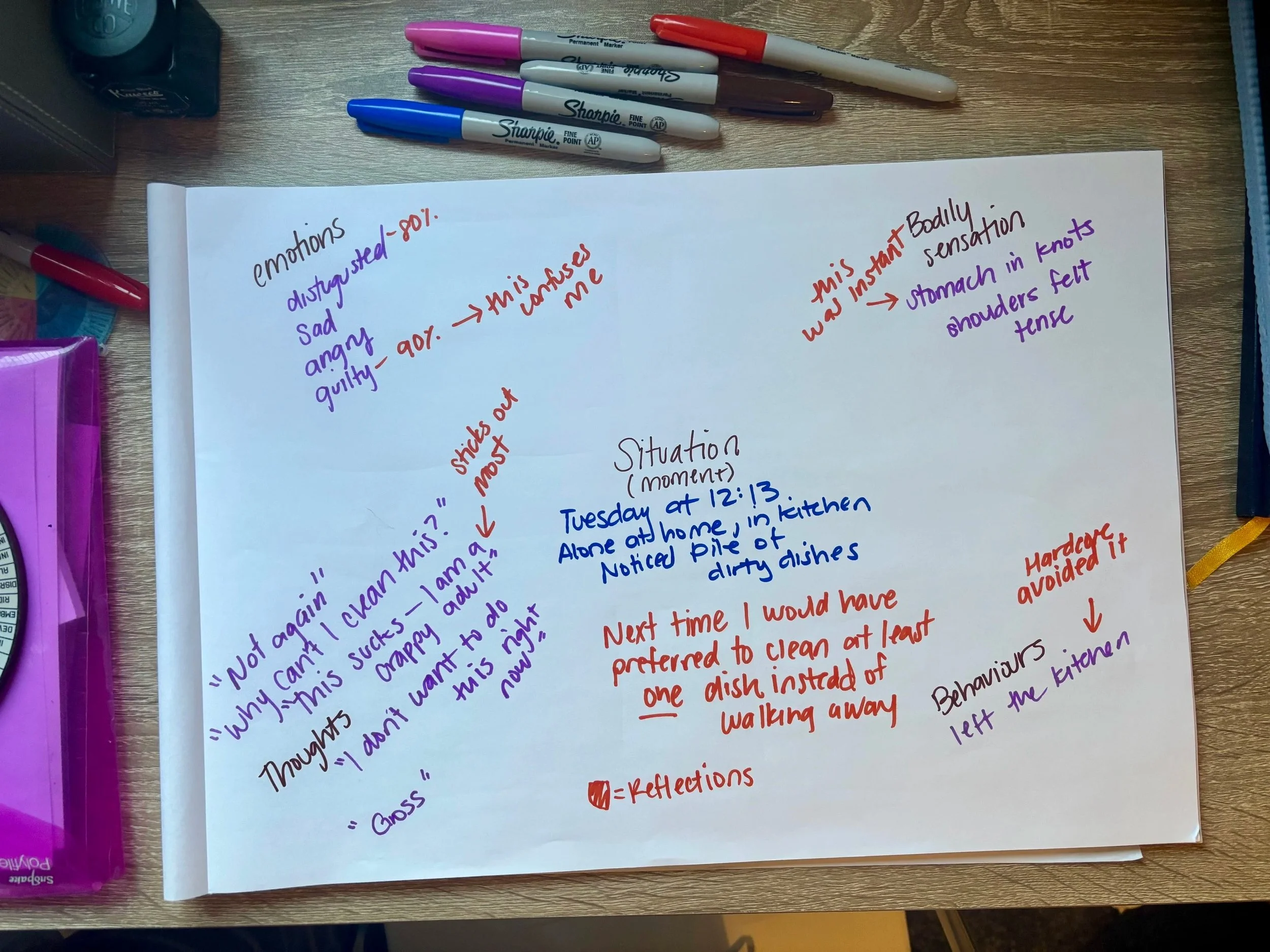
Picture of my version of a 5-Factor reflection of a moment in time. I used one colour for titles of sections (brown), another for the details of the sections (purple), and one more for the reflections I had once I was finished (orangey-red). You can also use a worksheet like this one (it is a PDF).
You’ll notice the result isn’t pretty, neat, or aesthetically polished. That’s fine—these moments rarely are. The goal isn’t perfection; it’s insight. With repeated use you may spot recurring patterns, which is completely normal. Whatever you choose to call it, this tool helps you learn about yourself from a single moment in time. Over time it fosters deeper self‑awareness and genuine personal growth.
Remember
Stay present while identifying the moment.
Record emotions, thoughts, sensations, and behaviours.
Highlight the strongest emotion and its associated thought. Rate it out of 100% if that helps.
Reflect on meaning and future actions.
Repeat whenever you need clarity.
Reflection doesn’t have to be a daunting academic exercise. By breaking it down into concrete steps, you can turn fleeting feelings into insights.
