
New Year, Same Me: Setting Intentions in 2026
Every December we hear the chant “New Year, New Me.” The promise feels powerful: the fresh calendar page will magically turn unfinished projects into completed ones. Yet, when January rolls around, many of us discover that the “new me” never arrived. We either over‑promise or we keep doing what we were already doing (just under a different label).
That gap between expectation and reality is where the trouble begins. Do we really have to check every resolution off the list within twelve months? What if the goal isn’t about finishing everything, but about showing up in a way that feels meaningful?
I like to think about the new year in a similar fashion, where it is a new beginning where we indeed can start anew, but I don’t think it should add any pressure to your life. So in 2026, why not try replacing resolutions with intentions.

How to Set Meaningful Intentions
Choose Your Focus Areas
Identify the life domains you want to nurture this year: creativity, health, family, friendship, community, sport, etc. Pinpointing values gives your intentions a clear anchor and reduces overwhelm. For me, I love creative writing. It is something that has been a hobby of mine since I a young girl, but last year I didn’t touch my notebook of ideas and musings. So one of my key areas is creativity.Add Concrete Details
For each focus, pick a tangible cue or object that reminds you of the intention. Example: My notebook of ideas for creativity. Concrete cues act as mental triggers, making the intention easier to recall in daily life.Set a Realistic Expectation
Decide how you’ll honor the intention. Ask yourself: How often? How much time?Frequency: “Once a month I’ll open my notebook and write for 10 minutes.”
Quality: “When I feel stressed, I’ll pause, breathe, and remind myself of my creative intention.”
Small, achievable steps build momentum and prevent the all‑or‑nothing mindset that fuels burnout.
Build a realistic expectation! It doesn’t need to be pretty or super specific. While there are of course wonderful tools for people who want to achieve goals in the new year (Tip: If you enjoy structured goal‑setting, you can translate an intention into a SMART goal (Specific, Measurable, Achievable, Relevant, Time‑bound) while keeping the overarching, flexible spirit intact.), however, the idea of intentions is that they are there in the moments you need them. If you found in the last year you had moments of stress and needed to take a step back, your intentions offer you something to think about in those moments.
Here is what mine looks like:
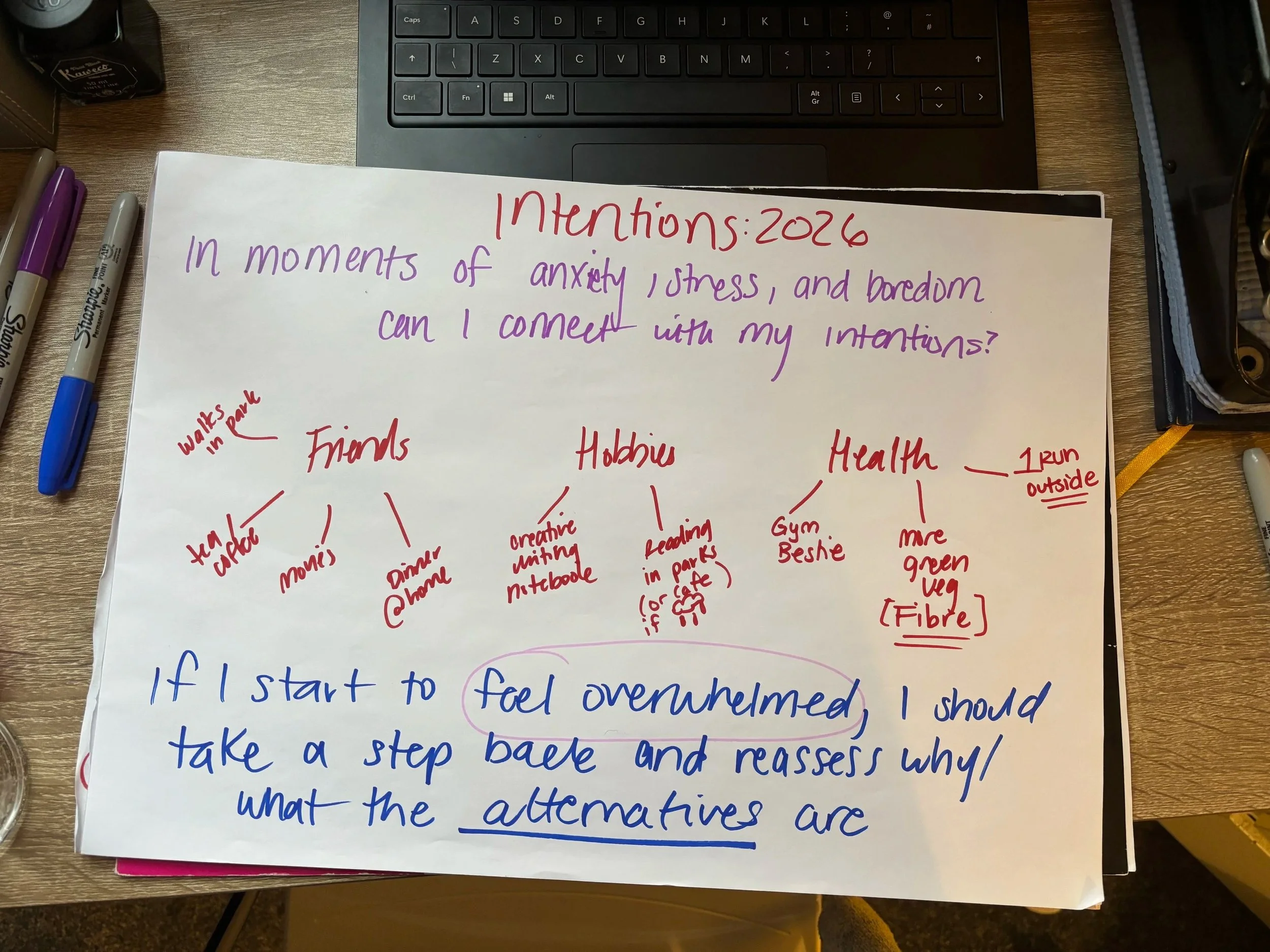
My very own intentions for 2026.
Bringing Intentions Into Everyday Life
This is not meant to be binding, nor inflexible - but simply something to think about first. Intentions give us directions when we may be unsettled. It offers a little more purpose with our thoughts if they seem to be running wild. If something you have written causes you stress, perhaps considering why you wrote it to be begin with. Setting intentions is only for you and no one else, so give yourself a chance to connect with the things you want to in 2026.
Create a visual reminder. Write your top three intentions on a sticky note and place it where you’ll see it daily (mirror, laptop lid, fridge).
Check‑in weekly. At the end of each week, ask yourself: Did I honor any of my intentions? What worked? What felt challenging? Record a brief note; patterns will emerge.
Practice self‑compassion. If you struggle - that’s okay. Gently revisit the intention, adjust the expectation if needed, and try again.
Take a moment right now:
Pick one focus area that feels most alive for you.
Identify a cue (an object, a place, a reminder).
Set a tiny, realistic action for the coming week.
Write it down, keep it visible, and notice how it subtly shapes your days.
